Thursday, July 15, 2010

How to Improve Your Running Posture

If you want to maximize your running to its fullest or continue your running without encountering any serious injuries, it is imperative that you improve your running posture.

It will be great if you have a camera and a friend who is willing to take a video of you when you run. But if that’s impossible, trying running on the spot in front of a cabinet mirror or running in front of a large mirror in the gym.

Now, while you are running, take a good look at your back and ask yourself these following questions.

Is my back perfectly straight? If it is and your shoulders and neck don’t feel tensed at all, then congratulations! Your running posture is good to go! But if you use this posture in a marathon, you will eventually feel tense. And when you do, lean forward just a little bit from your waist and you’ll be fine.

Do I lean forward just a little bit from my waist? If you do, then double congratulations to you! This kind of running posture is actually considered the most efficient! Here's a picture of the most efficient running posture.
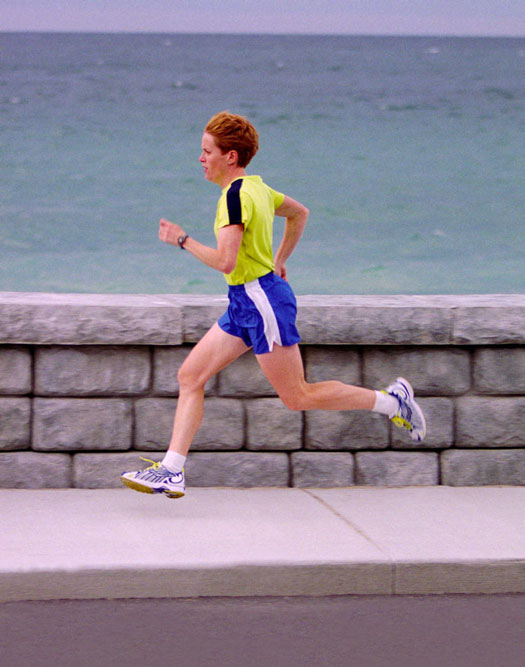


Do I lean far forward from my waist so much that it looks like I may fall anytime? If you do, try pulling your back to the perfectly straight posture or the slight lean forward posture as soon as possible; otherwise, there will be a lot of pressure on your lower back. And since your gaze is always fixed on the ground, you may end up hitting a lamp post as well.

Do I lean back at my waist in a way that it looks like I’m running downhill? If you do, try leaning forward slightly at the waist; otherwise, you won’t be able to breathe so well, which results in a much decreased endurance. Also, trying bringing your chin down because it is very likely that your chin is now a little tipped back.

Next, take a look at your shoulders and ask yourself this question.

Do I scrunch my shoulders so much that they are up to my ears? If you do, try relaxing your shoulders and holding them slightly backward. Remember, running with relaxation equals running efficiently. If you don’t relax, your running will be a lot more difficult than it should be.

Finally, take a look at your neck and ask yourself this question.

Do I tilt my chin up so much that it points to the sky? If you do, try keeping your neck down. Many runners tilt their chins up when they are exhausted all the time. But ideally speaking, your neck needs to be perfectly straight in order for you breathe properly.

Happy Running, Everyone!

Wednesday, July 14, 2010

5 issues to consider before joining a running club


For those of you who want to join a certain running club, there are 5 things you need to consider.

1. The Fitness Level of the Club's Members

If you are too fit for the other members, running will be boring for you. On the other hand, if the others are too fit for you, running will be tiring for you. This is why it is very important to check the club’s training pace and mileage target before you join it.

2. The Club’s Racing Schedules

It is uncommon for many runners to want to participate in a certain marathon, but unable to do so because their clubs have another marathon planned out for them already. To prevent this from happening, check out the club’s schedules for racing events they are planning to run before you join it.

3. The Club’s Workouts

Each club has its own ‘workout recipes’ for its members. If you feel that you aren’t comfortable with their types of workouts, you’d better find yourself a new club. Don’t try to force yourself to do something you don’t want to. If you do that, running will be no fun!

4. The Club’s Joining Fees

There are clubs that will provide you some basic running kits or motivational speakers…some will even go as far as to hold a social event every now and then! Ask yourself whether you want these things or not because you will be the ones who pay all of these out of your joining fees!

5. The Club’s Greed for Prize Money (LOL!)

This will become a big problem if you are a capable runner who always wins races. Some clubs will be okay if you just keep all the prize money, but there are some that will expect you to share your prize money with them. Therefore, before you join a club, do take this issue into considerations!

Happy Running, Everyone!

Tuesday, July 13, 2010

5 simple tips when training to run a marathon


Even for an experienced runner, training for a marathon race is not at all easy since it requires an insane amount of mental and physical fitness that not everyone possesses. But don’t be scared. Although training for a marathon is hard, it will become a lot easier if you take these 5 simple, yet helpful, tips into consideration.

1. Start early

If you are new to running a marathon or haven’t been in a gym lately, it is advisable that you start training as early as 6 months prior to the actual race. This way, you will have more than enough time to get all the necessary things you need done without overexerting yourself.

2. Tone things down before the race

If you have been training yourself in a marathon style for 4-6 months, it is essential that you tone things down 2 weeks before the race by either doing the minimal training or simply not training at all so that your muscles can have some time to rest.

3. Eat well

What you eat will not only contribute to how you look, but also to how well you perform in the race as well. For your body to have enough energy to survive the race well, you will need a lot of carbs and protein. The examples of what you should eat are pasta, baked potatoes, cheese, chicken, sunflower seeds...you get the idea.

4. Practice pacing

Most runners find out that they tend to get super excited when they are in a race, especially in a long one like a marathon. One result of this excitement is that they will start off a little too strongly and become extremely exhausted before they can reach the finish line. To prevent this from happening, you should practice pacing until your legs can remember it. This way, no matter how excited you are, you will never burn yourself out too early in the race, ever.

5. Walk if you want

Even if it is a race, it does not mean you have to push yourself by continuing to run from the starting point to the finish line. In fact, a combination of running and walking through the entire race actually yields better results than simply keep on running until you reach the finish line!

I wish you all happy running!

Sunday, July 11, 2010

5 common mistakes most people make when going running


Running is usually a very enjoyable activity; however, many runners aren’t really enjoying it at all and here are the main reasons why:

Century-old shoes

Generally, a pair of running shoes must be discarded every 300-400 miles of running. Some runners, however, refuse to do so because they like their old, half-broken shoes better. This is probably why knee, hip and other joint problems happen to runners so much that it has become the most common running injuries nowadays.

Getting too pumped up in a race

Many new (and old) runners get very excited in races. They tend to start running a lot faster than they usually do, only to end up being exhausted long before they reach the finish line.
The best way to prevent a runner’s crash like this is to always keep calm and be aware of your own pace before the race even starts. And when you start running, it is advisable that you run among the middle or even the back of the pack. Doing this ensures that you will have enough strength to finish off strong and that you will not be tempted to overexert yourself by the sight of those lightning-speed gods.

Overstriding

Overstriding is when runners land on their heels, with the entire foot in front of the body’s center of gravity. At first glance, overstriding seems like a good way to increase your speed. But the braking motion caused by each foot strike tells us that overstriding actually decreases your speed and also increases your chance of getting injured dramatically!
The best way to prevent yourself from overstriding is to pay attention to your running form, especially when you are running downhill. It is ok if you can’t run at full-speed yet. Just focus on your form until your motion becomes natural first.

Not drinking enough fluid

Getting cramps is one of the greatest problems in the history of running. Some runners try to prevent this by not drinking water at all before they run. This is a huge mistake. If you don’t want to get cramps, doing proper warming up before you run and taking some deep breaths while you run are more than enough.
It is essential that you drink water before, during and after you run: 16-24 ounces of water one hour before you run, 6-8 ounces of water every 20 minutes of running, and 20-24 ounces of water for each pound lost after the run.

Too much training

“The more you run, the better off you will be.” This kind of thinking can be found in many runners, especially those who are training for races. Unfortunately for them, this is not true at all! Constant training only makes you feel like you are progressing rapidly, but in reality, it will only result in burnout, injuries and a huge decrease in speed and efficiency!
If you are trying to build up for a longer race, you should limit your increase in mileage to no more than 10% each week. If you just finish a hard run, it is essential that you take a day off to allow your muscle to recuperate. And in every 4th week of running, you should drop your weekly mileage to 50% to rest your muscles. Remember, resting is also part of training.

I wish all of you happy running!